Alligator, Caiman, or Embossed Calfskin: What You Pay For
Three belts can look almost the same across a counter and cost $125, $345, and $575. The difference is the hide, not the pattern. American alligator is a genuine crocodilian skin, tagged under CITES, and it sits at the top of the range. Caiman is also a genuine crocodilian, a different and far more plentiful species, with a bonier tile and a firmer hand, at roughly a third of the alligator price. Embossed calfskin is calfskin stamped with an alligator grain under pressure. It is not an exotic, we do not call it one, and it is the cheapest of the three by a wide margin.
What you are paying for is the skin. What you are looking at is the pattern. Those are not the same purchase.
Key takeaways
- American alligator and caiman are both real crocodilian hides from different species. Embossed calfskin is cow, stamped.
- Price follows the hide: embossed calfskin around $125, caiman around $345, American alligator to $575.
- Alligator scales have no sensory pit. Caiman tiles are stiffened by bone under the skin. Embossed grain repeats.
- American alligator is legal to buy and own, and every hide carries a CITES tag from the state it came from.
- The most expensive of the three is not the best belt. It is a different belt.
What is the actual difference between the three?
Two of them are reptile and one of them is cow.
American alligator, Alligator mississippiensis, comes from farms and regulated wild harvest in the southeastern United States. The belly skin is the prize: wide, flat, rectangular tiles that lie flush and bend without breaking up. It is soft for a crocodilian, it takes a glaze or a matte finish cleanly, and there is not much of it per hide.
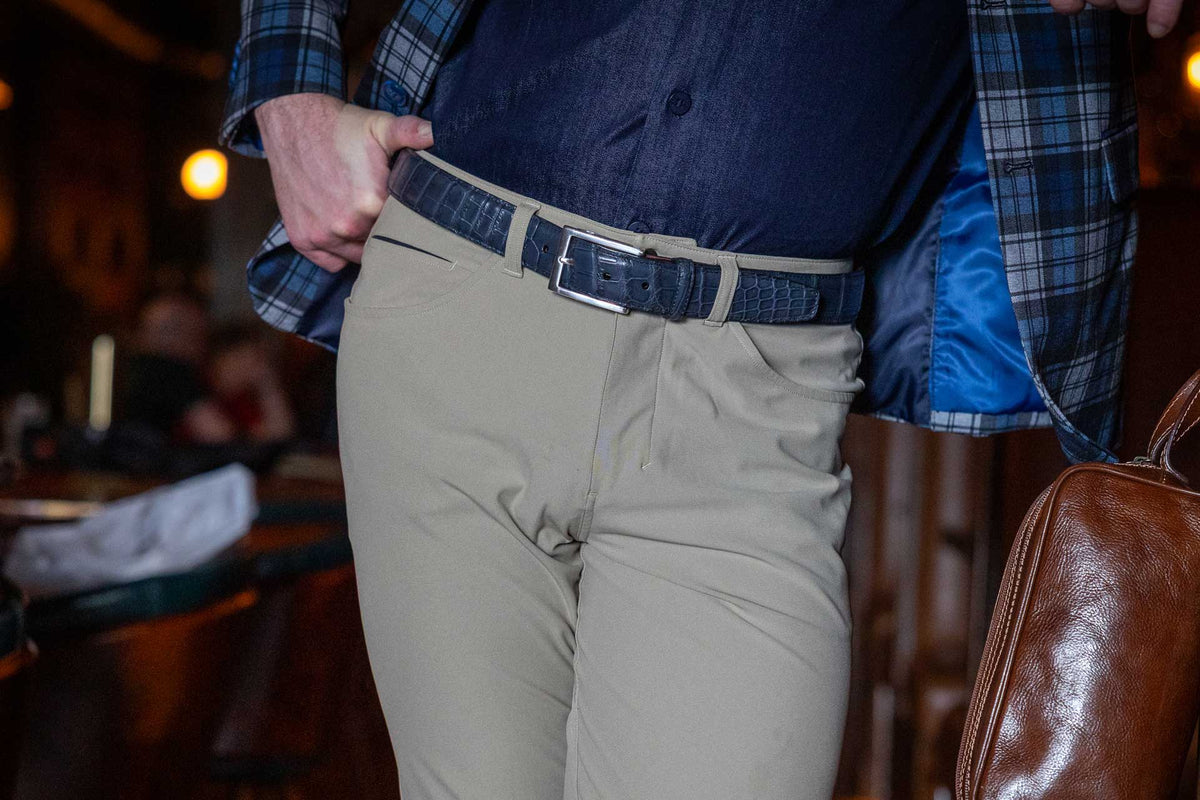
Caiman is a South American crocodilian, several species, farmed and harvested in far greater numbers. Same family, different animal, different skin. Caiman carries osteoderms, small plates of bone inside the scale itself, which is why a caiman belt feels firmer than an alligator belt of the same thickness and why the tiles are slightly domed and hard rather than soft and flat.
Embossed calfskin is a cowhide run through a heated press that stamps an alligator, hornback crocodile, or lizard grain into the surface. The leather underneath is ordinary good calfskin. The pattern on top is a die.
How do you tell them apart in your hand?
Three things, in order of how quickly they give it away.
The repeat. An embossed grain repeats, because a die repeats. Look down the strap and the same cluster of scales shows up again at a regular interval. A real hide never does this. Tiles change size as they run from the center of the belly toward the flank, and the pattern goes irregular near the ends.
The scale edges. On a real hide, the line between tiles is a seam in the skin, with depth and variation. On embossed calf it is a valley pressed into a flat surface, even in width and depth all the way down.
The hardness. Press a fingernail into the middle of a tile. Alligator gives. Caiman resists, because there is bone in there. Embossed calfskin gives evenly everywhere.
One more, since the category uses the words loosely: true crocodile scales carry a small sensory pit, a visible dot in each scale. Alligator and caiman do not have them on the belly.
Why does American alligator cost what it costs?
Yield and grading, mostly.
A belt strap needs a long, unbroken run of consistent tiles, and on an alligator hide that run exists only down the center of the belly, narrowing as it goes. One hide produces very few strips good enough to become a belt without piecing. Everything either side goes to smaller goods.
Then the strips have to be matched, because a belt has to read as one piece of skin. The tiles at the buckle end and the tip end need to be close in size and color, which means sorting a lot of material to find pairs. Add tanning, finishing, lining, and hand work, and you arrive at $520 for a standard belt and $575 at the top of the range. That is also why no two are identical. If we could not say why a belt costs $575, we should not be selling it at $575.
Why is caiman a third of the price?
There is far more of it, and it is a harder material to make soft.
There is far more of it, and it is a harder material to make soft. Caiman is abundant and farmed at scale, and the hides are smaller and bonier, so more of each hide is usable for straps but the result is stiffer. Around $345 buys a genuine crocodilian belt with real tile structure and a look nobody will mistake for cow.
The trade is flexibility. Caiman does not soften the way alligator does, and a caiman strap cut thin or left dry can craze at the buckle fold, meaning fine cracking between the tiles where the strap bends hardest. Rotate it, keep it out of a hot car, and it holds up. Wear it daily for two years and it will tell you about it.
You will also find caiman as a tab or accent on a woven stretch strap, starting around $180. That is real caiman, just not much of it, and it is the cheapest honest way to own some.
Is embossed calfskin a fake?
No. It is calfskin, and calling it calfskin is the whole point.
A stamped grain is a legitimate finish with a long history, and a well made embossed calf belt at $125 is a good belt. It takes a polish, it holds its color, and it does the job an alligator belt does at a fifth of the price for anyone who is not buying the hide itself. What makes it a problem is the labeling, not the leather. The FTC's Guides for Select Leather and Imitation Leather Products are explicit that when a product has been embossed, dyed, or otherwise processed, the kind and type of leather it is made from should be disclosed. Half the category ignores that and sells "gator belts" that are cow. We do not, which is why our embossed styles carry the grain in the product title: Italian alligator grain calf, hornback crocodile embossed, lizard grain. If the title says grain or embossed, it is calfskin. If it does not, it is the animal named.
That is worth more than any adjective on the page, because it means you can shop the embossed styles and the genuine exotics without interrogating anybody about which is which.
Belly, hornback, glazed, matte: reading the listing
Four words do most of the work in an exotic belt listing.
Belly is the flat tile pattern from the underside. Dressiest cut, most flexible, most expensive, because it is the part everyone wants.
Hornback is the ridged spine, with raised bony scutes down the middle. Dramatic, much stiffer, and reads western or casual rather than formal. It is also the cut most often imitated in embossed calf, because the pattern is bold enough to survive being pressed into cow.
Glazed means polished under pressure to a high shine. Formal, shows scratches, belongs with a suit. Matte means the finish is left flat: more forgiving, dresses down further, and the safer of the two if the belt is going to be worn often.
Glazed belly alligator in black is the belt for a dark suit. Matte hornback anything is not, whatever it cost.
Is it legal to buy an American alligator belt?
Yes, within the United States, and the paperwork behind it is the reason the animal still exists in the numbers it does.
American alligator was listed as endangered in 1967, recovered, and now sits on Appendix II of CITES, the international convention governing trade in protected species. Under the system the US Fish and Wildlife Service runs with the states, every harvested alligator receives a tamper resistant, self locking tag with a unique barcode recording when and where it was taken. The tag follows the hide.
Two notes. Other hides carry different rules, and restrictions vary by state and by destination country, so check before shipping an exotic belt outside the US. And the authority here is USFWS and CITES themselves rather than a retailer's blog post, so their material on the alligator export program is the place to go for the full picture.

Which one should you actually buy?
The $125 embossed calf, for most buyers. It looks like what you wanted, it is a good belt on its own terms, and if it gets ruined in three years you will replace it without thinking about it.
Buy caiman at $345 if you want a real hide and the texture is the point. Buy American alligator at $520 or above if you want the material itself, you will wear it with tailoring, and you understand you are buying a hide rather than a look.
Neither one is the good one. Three different purchases that happen to share a pattern, and the only wrong move is paying exotic money for a stamp.
Everything real sits in Exotic Belts, split by species into alligator, caiman, and ostrich. Everything stamped sits in Embossed Exotic Belts, and the titles say so.
Common questions
Is caiman the same as crocodile?
No. Caiman is its own group of species within the alligator family, native to Central and South America. Plenty of belts sold as crocodile are caiman, which is why we name the species rather than using a category word.
How can I tell if an alligator belt is real?
Look for a repeating pattern down the strap. A die repeats and a hide does not. Then check whether the seller names the species and the cut. A listing that says "exotic leather" and nothing else is telling you something.
Does an alligator belt last longer than a calfskin one?
Not necessarily. Alligator is durable, but so is good calfskin, and both fail at the buckle fold first if they are worn daily and never rotated. Worn in rotation and kept away from heat, a decade is normal for either. Care and rotation matter more than the animal.
What size should I buy in an exotic belt?
The same size as any other belt: trouser waist plus two inches, measured from the buckle fold to the middle hole. The sizing rule does not change with the hide.
Buy the hide or buy the pattern, but know which
Kest Leather names the species and the finish on every belt, and prices follow the material rather than the marketing. Start in Exotic Belts if you want the skin, and Embossed Exotic Belts if you want the look.

Written by Logan Wood
Founder of Kest and a certified master bespoke clothier. He has worked in fine men's clothing since 2017 and handpicks everything Kest carries.