How to Make a Leather Belt Last Ten Years
Rotation, not conditioner. A belt worn every single day fails at the buckle fold, where the strap bends tight around the frame every time you put it on. Two belts alternating will each outlast one worn daily, because the leather gets time to recover between wears. Everything else is maintenance: wipe the dust off with a dry cloth, condition smooth leather sparingly and rarely, brush suede instead of oiling it, dry it away from heat if it gets soaked, and store it rolled or hung flat rather than folded over a hook.
Worn in rotation and kept out of the dryer, a decade is normal. Leather is a material, not a promise.
Key takeaways
- Rotation is most of care. A belt worn daily fails at the buckle fold first.
- Condition smooth leather about twice a year, using far less product than you think. Too much darkens leather permanently.
- Brush suede. Never oil it.
- Store belts rolled or hanging flat. Folding one over a hook puts a crease where you least want one.
- Chrome tanned and finished leathers hold their color instead of taking a patina. Design, not defect.
Where does a belt actually fail?
The buckle fold. The strap wraps back on itself around the buckle frame, a tighter bend than the leather takes anywhere else, cycling every time you fasten the belt. Dry leather there goes brittle and cracks across the strap. That is the crack you see on old belts, and it is what kills them.
The holes. The prong puts the entire load on the edge of one hole. Use the same hole daily for years and the fibers separate and the round hole slowly ovals. Normal wear, not a defect, and the reason a belt sized to sit in the middle hole ages better than one sized to sit in the last.
The finish. Sweat, sun, and friction against belt loops take the surface first. On a burnished or aniline belt that reads as patina. On a heavily coated belt it reads as wear.
Why rotation does more than anything you can buy
Leather recovers. Under load the fibers compress and the strap stretches slightly, and given a day off most of that comes back. Worn seven days a week it never gets the chance, and the deformation becomes permanent.
So own two and alternate them, the way you would with shoes. It is dull advice and no brand wants to give it, because the honest recommendation is a second belt rather than a bottle of conditioner. Two $120 belts alternated will outlast four worn to death one at a time. A dress belt and a casual belt are not two versions of the same object anyway, for reasons set out in the guide to buying a men's leather belt.
How often should you condition a leather belt?
Twice a year for smooth leather, and use less product than feels right.
Conditioner replaces the oils daily wear pulls out of the fiber structure, and those oils are what let the leather flex at the fold without cracking. That much of the standard advice is true. What it leaves out is that over conditioning is the more common mistake. Too much product darkens leather permanently, softens a strap that was meant to hold its shape, and leaves a surface that attracts dust. More belts die from an enthusiastic weekend with a tin of dubbin than from neglect.
The method is short. Wipe the strap with a dry cloth first, since conditioning dirt into leather only moves the dirt deeper. Put a pea sized amount of neutral conditioner on a cloth, not on the belt. Work it in with light circular pressure, paying attention to the buckle fold, which is the part that needs it and the part everybody skips. Let it absorb for an hour, then buff. If the belt looks wet, you used too much. Skip all of this on suede, nubuck, and heavily pigmented finishes, where the product cannot get in and sits on the surface instead.
Suede, woven, and exotic belts want different things
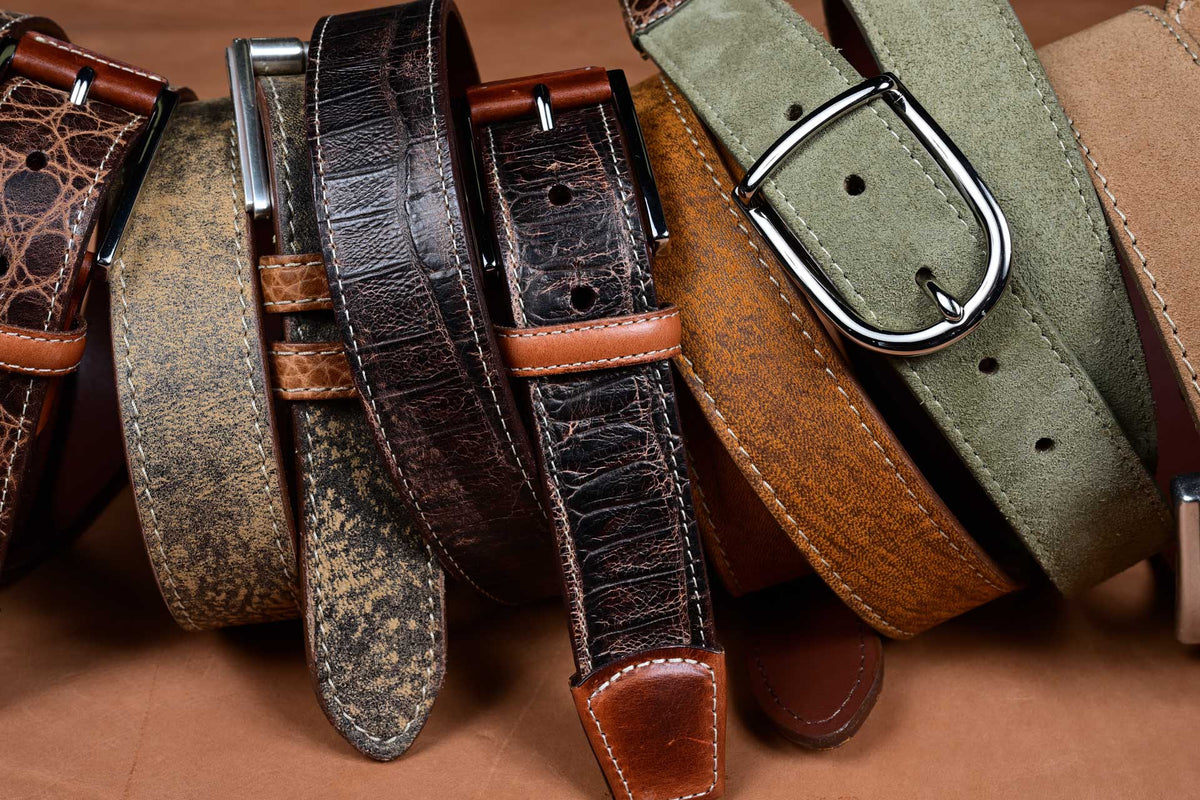
Suede wants a brush and dry weather. Work a suede brush in one direction to lift the nap, and use a suede eraser on shiny spots where it has been crushed flat. Do not oil it, do not condition it, do not wear it in the rain. Suede is honest about being a fair weather material and it is worth taking it at its word. Suede Belts.
Woven and stretch belts want to be left alone. Elastic or fabric is doing the work, so there is nothing for conditioner to soak into. Keep them out of the wash and off a radiator, and expect the give to shorten over several years. That is the elastic aging, and it is not repairable.
Exotic hides want less than people assume. Alligator and caiman scales do not absorb product the way smooth calf does, and the seams between tiles hold whatever you push into them. A dry cloth and a very light touch at the fold once a year. Caiman is the one to rotate hardest, since it crazes at the fold sooner than alligator, as covered in the alligator, caiman, and embossed calfskin comparison.
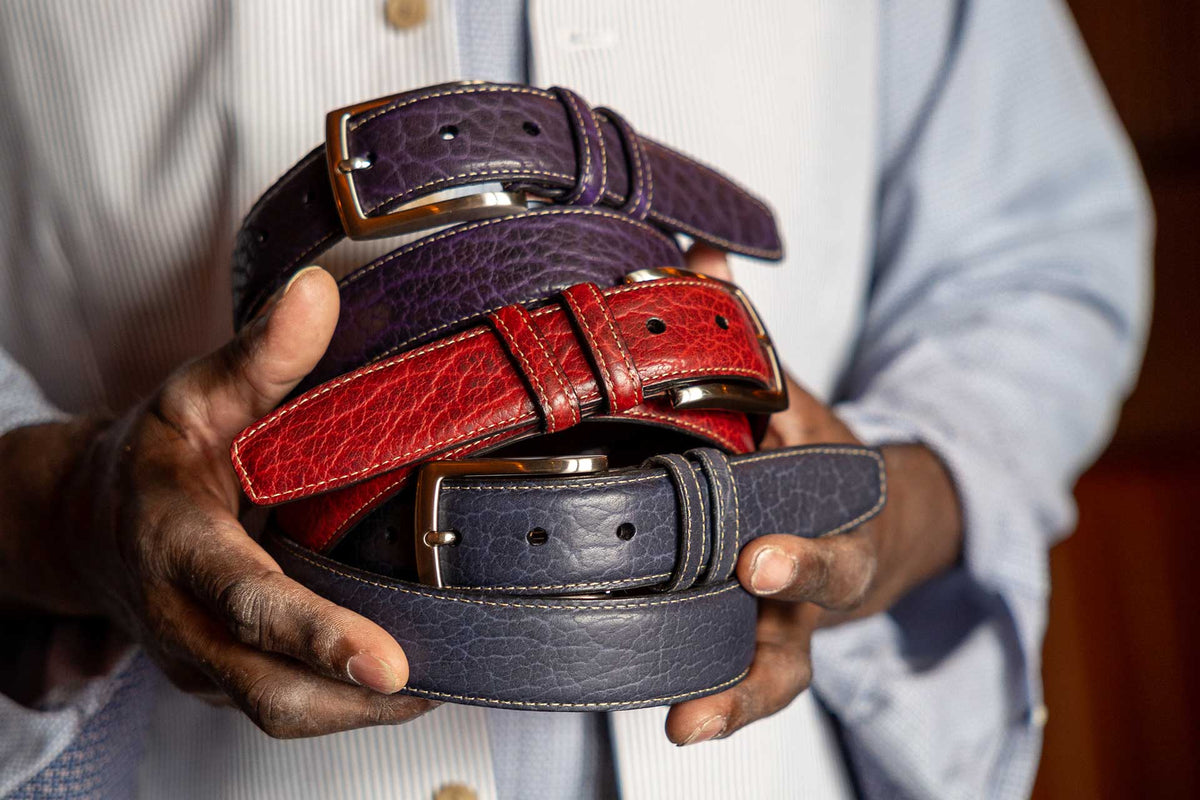
Bison wants nothing at all. The pebble grain scuffs, and the scuffs look good, which is most of the reason to buy one.

Storage, stretch, and what cannot be fixed
Store belts rolled with the buckle in the middle, or hung flat. What you are avoiding is a sharp crease: fold a belt over a closet hook and within months that fold is a permanent weak point, cracking the same way the buckle fold does in a place with no reason to bend. Keep them out of plastic bags and away from heating vents, since dry winter heat pulls moisture out faster than daily wear does.
Belts relax slightly in the first few weeks and then hold. What reads as continued stretching is usually the holes ovalling. Any shoe repair shop will punch a new hole for a few dollars, though none of it saves a hole that has already torn through, so do it early.
Two things cannot be fixed. Cracks, because once the surface fibers have fractured the damage is structural. And heat, because a belt that has been through a dryer or dried on a radiator has had its fiber structure cooked and stays brittle. If a belt gets soaked, blot it, lay it flat, and let it dry slowly at room temperature. Water is survivable. Heat is not.
Where this shows up in what you buy
Construction decides how much of this you have to think about. A single thickness strap with burnished edges has nothing to delaminate and nothing to peel, so it fails slowly and predictably at the fold. A thin coated strap fails faster and less gracefully, and no care changes that. The belts that reward this kind of attention are the smooth leathers in Calfskin Belts and the natural grain hides in Bison Belts.
Common questions
How long should a leather belt last?
Worn in rotation and kept away from heat, a decade is normal. Worn daily with no rest, considerably less. Nobody can guarantee a lifespan, and any brand that does is describing a warranty policy rather than a material.
What conditioner should I use?
A neutral, pH balanced leather conditioner. Avoid mink oil and heavy waxes on dress leather, since both darken it permanently. Test on the back of the strap first.
Why is my belt cracking near the buckle?
Fold fatigue. The leather at the fold has dried out and lost flexibility, and the repeated tight bend has fractured the surface fibers. It cannot be reversed. Conditioning the fold twice a year on your next belt prevents it.
Should my belt develop a patina?
Only some will. Aniline and lightly finished leathers darken and take on character with wear. Chrome tanned and pigmented leathers are made to hold their original color, which is exactly what you want from a black dress belt. Neither one is the good one.
Buy the second belt
If you take one thing from this, take the rotation. It costs more up front than a tin of conditioner and it does more than any product will. Start with something that does a different job from the belt you already own, in the full belt collection.

Written by Logan Wood
Founder of Kest and a certified master bespoke clothier. He has worked in fine men's clothing since 2017 and handpicks everything Kest carries.