How to Buy a Men's Leather Belt
Six decisions, in this order: size, width, dress or casual, leather, buckle, and price. Size is trouser waist plus two inches, measured from the buckle fold to the middle hole. Width is set by the job, 1 1/8 to 1 3/8 inches for suits and tailored trousers, 1 3/8 to 1 1/2 inches for denim and chinos. Dress and casual differ in width, finish, and buckle, and they are not interchangeable. Leather is where the money goes, and the terms matter, because full grain, top grain, and genuine leather are not a quality ladder in the way most sites imply. The buckle should be plain, solid, and proportionate to the strap. Past about $150, you are usually buying a rarer hide rather than a longer life.
Key takeaways
- Size first: trouser waist plus two inches, measured buckle fold to middle hole.
- Width is a fit decision, not a style one. Dress trouser loops will not take a 1 1/2 inch strap.
- "Genuine leather" is a regulated term with a meaning most shoppers get backwards.
- Vegetable and chrome tanning produce different behavior, not better and worse leather.
- Above roughly $150, price is buying you a rarer hide, not more years.
The decision you are actually making
A belt is the thing you put on every morning without thinking about it, right up until it is wrong. Too shiny for the shirt. Too stiff to sit down in. Too wide to thread the loops on the trousers you bought it for.
Getting it wrong is cheap in money and annoying in practice: the belt sits in a drawer and you go back to the one that cracked. Getting it right is about ten minutes of decisions, and the trousers make most of them for you.
What size belt should you buy?
Trouser waist plus two inches. A 34 waist takes a 36 belt.
Belt size measures from the buckle fold, the crease where the leather turns around the buckle, to the middle hole. It is not the total length of the strap, which is why a 36 belt measures closer to 40 inches of leather. A strap typically carries five holes an inch apart, so a 36 fastens anywhere from about 34 to about 38.
If your waistband labels are optimistic, and most are, thread a soft tape through the belt loops of the trousers you actually wear and round up to the next even number. Between sizes, size up: a long belt can be shortened at any leather shop, and a short one cannot be saved. Full detail, including how to measure a belt you already own, is in the belt sizing guide.
If you wear 48 or above, the rule is the same and the shortlist is shorter. Most of the category stops at 44. Select styles here are cut 48 through 60 across the same range of leathers as the rest of the line, and they sit in Extended Sizes. Extended sizing is style by style rather than something every belt offers, so check the style rather than the brand.
What width do your trousers want?
Measure the belt loops on the trousers, not your waist. This is the decision people skip and then regret at the shop counter.
- 1 1/8 inches. Narrow. Formal suits, evening trousers, anything with slim loops. Reads dressy and can look thin under a heavy jacket.
- 1 3/8 inches. The one belt to own if you are only owning one. It threads dress trouser loops, it works with chinos, and it does not look undersized with a sport coat.
- 1 1/2 inches. Jeans, heavy chinos, workwear. Will not go through most dress trouser loops, and looks heavy on tailoring.
One belt doing everything: 1 3/8. Two belts: narrow for tailoring, wide for denim, and stop making either do the other job.
Dress belt or casual belt: the four differences
Four things separate them, and none of them is price.
Width. Dress narrow, casual wide. Covered above, and the difference that will physically stop you wearing the wrong one.
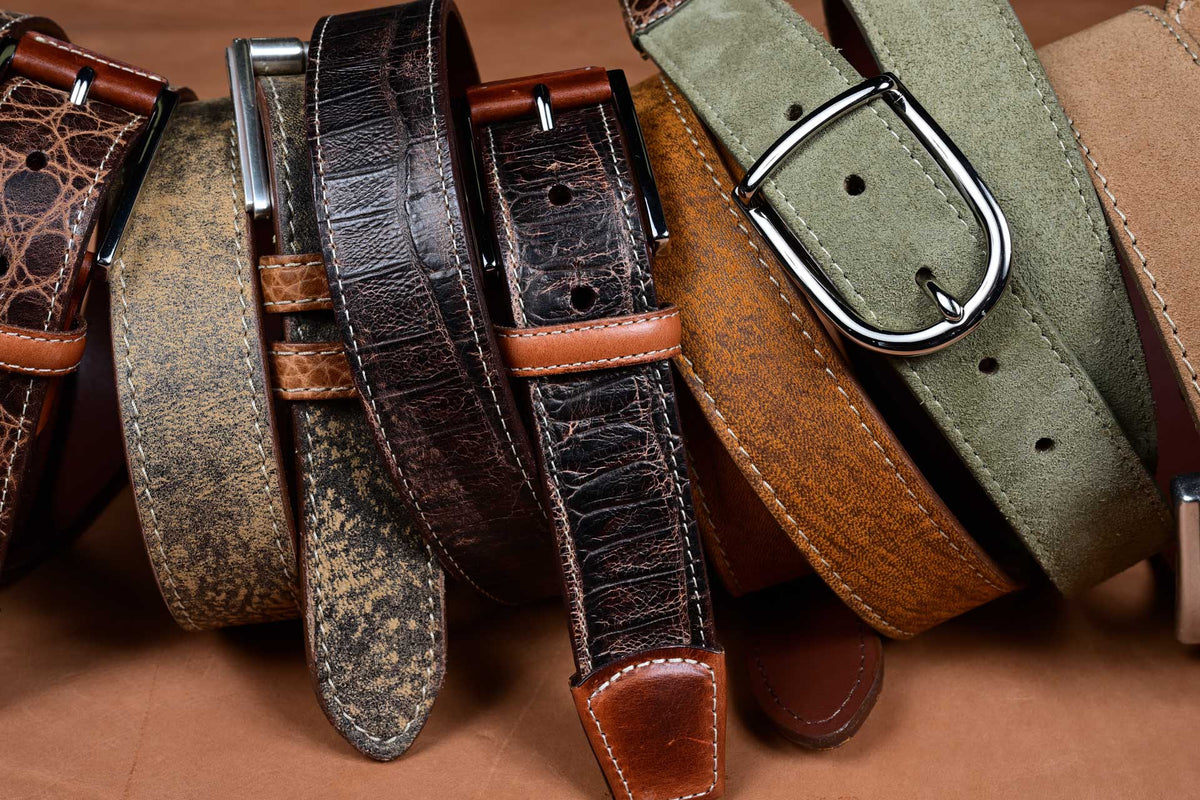
Finish. A dress belt has a smooth, quiet surface. A casual belt has visible texture: pebble grain, tumbled leather, suede nap, a weave, a braid, contrast stitching.
Buckle. Dress buckles are small, flat, and plain in polished nickel or brass. Casual buckles are larger, often brushed or antiqued, and allowed to be visible.
Edge. Dress belts have a burnished or painted edge, often with a stitched border. Casual belts more often show a raw or rolled edge, which reads relaxed rather than unfinished.
Start in Dress Belts or Casual Belts depending on which trousers the belt is for. If it is for the course, Golf Belts are their own thing, because four hours in a cart is a specific problem and a stiff strap is a poor answer to it.
Full grain, top grain, genuine leather: what the labels mean
These get used as a quality ladder and they are not one. They describe how much of the hide surface is left intact.
Full grain keeps the outer surface of the hide exactly as it came off the animal, pores, healed scars, variation and all. It is the strongest layer and it takes a patina, which is why the leatherworking world treats it as the standard.
Top grain has had that surface sanded to remove blemishes, then usually finished. More uniform, slightly less strong. On a dress belt where you want an even black surface, that is a legitimate choice rather than a compromise.
Corrected grain is top grain sanded further with an artificial grain pressed back in. This is where value starts dropping quickly.
Genuine leather is the term to be careful with. Colloquially it sounds like a guarantee of authenticity. In practice it is often used on lower layers of the hide with a finish applied. The FTC's Leather Guides govern how these terms can be used and require that non-leather content be disclosed on material that looks like leather but is not. Worth knowing before you read another product page.
Bonded leather is leather dust and scrap adhered to a backing. It is not a belt material. It delaminates.
Vegetable tanned or chrome tanned?
Neither one is the good one. They are two processes that produce leathers with different jobs.
Vegetable tanning uses plant tannins over weeks. The result is firm, holds a shape, burnishes well, and darkens with use. If you want a belt that visibly ages, that is the process behind it.
Chrome tanning uses chromium salts over a day or two. Softer, more water resistant, far more consistent batch to batch, and it holds its original color for years instead of changing. A black dress belt has a different job from a natural bridle strap, and that job is not looking ten years old.
Here is the part most guides will not tell you: across this category, including here, the tannage is very often not stated anywhere on the page. So judge by behavior instead. Firm, thick, matte, natural in color, and it darkens in the hand: probably vegetable tanned. Soft, even, saturated color, water beads on it: probably chrome tanned. If a specific belt's tannage matters to your purchase, ask before you buy rather than guessing from the photograph.
Calfskin, kipskin, bison, suede, deertan
Use the actual noun. Most of the category says "premium leather" because the specific word would invite a question.
Calfskin is hide from a young cow. Fine grain, smooth, takes a high finish, and the reason a dress belt looks quiet at three feet. Finishes vary a lot: Italian, burnished, Bulgaro, pebble grained, shrunken, tumbled. Those words describe surface treatment, not quality tiers. Calfskin Belts covers the range.
Kipskin sits between calf and full grown cowhide. Heavier and coarser than calf, still fine grained, and a good middle answer for a belt that has to look tidy and take abuse.
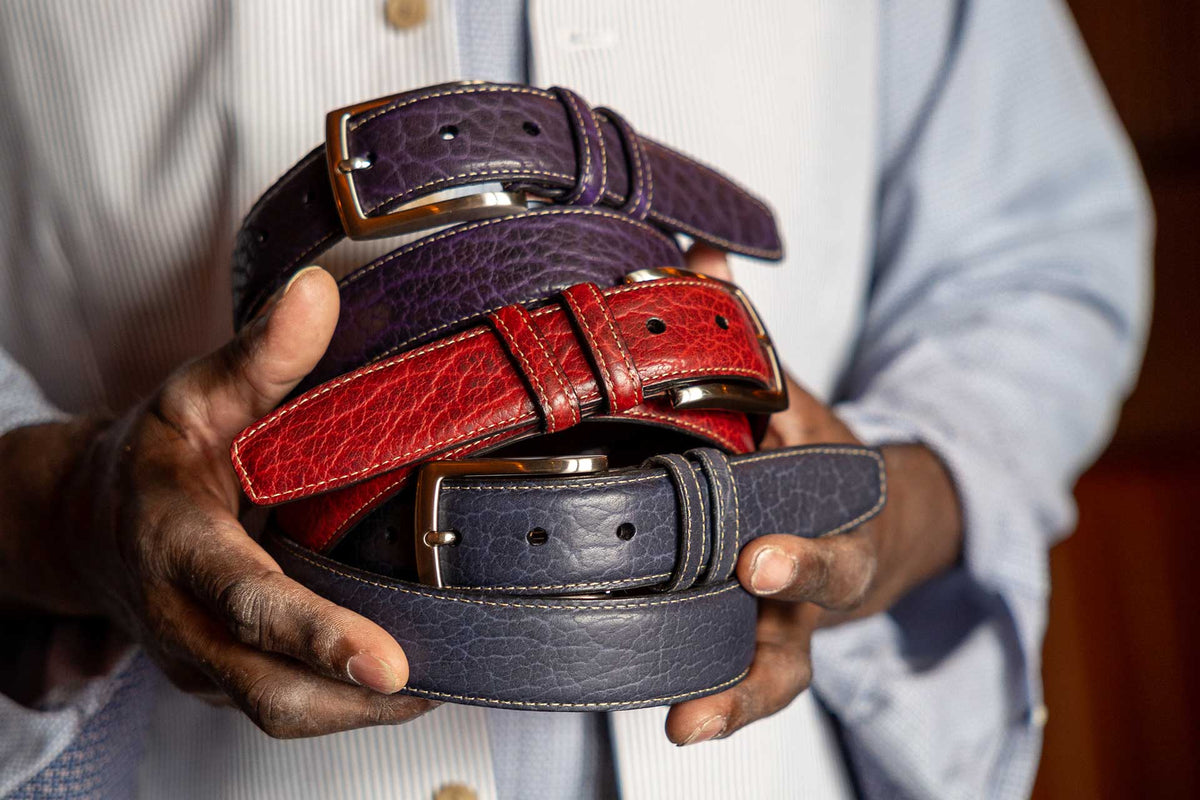
American bison has a deep, irregular pebble grain and a soft hand for its weight. It scuffs, and the scuffs look good, which is either the whole appeal or a dealbreaker. Bison Belts.
Suede calfskin is the flesh side napped up. Soft, casual, and specific about conditions: suede wants dry weather and a brush. Outdoors in the rain regularly, buy something else. Suede Belts.
Soft deertan glove leather is deerskin, not calfskin, and the softest thing on the list. It drapes rather than holds shape: a comfortable casual belt and a poor dress one.
Surcingle is cotton webbing with leather tabs, borrowed from horse tack. Cheapest thing in the range at $65, meant to look casual, and it does the job it advertises.
Exotic hide or embossed grain?
This is the biggest price gap in the category and the one where the language is most often abused.
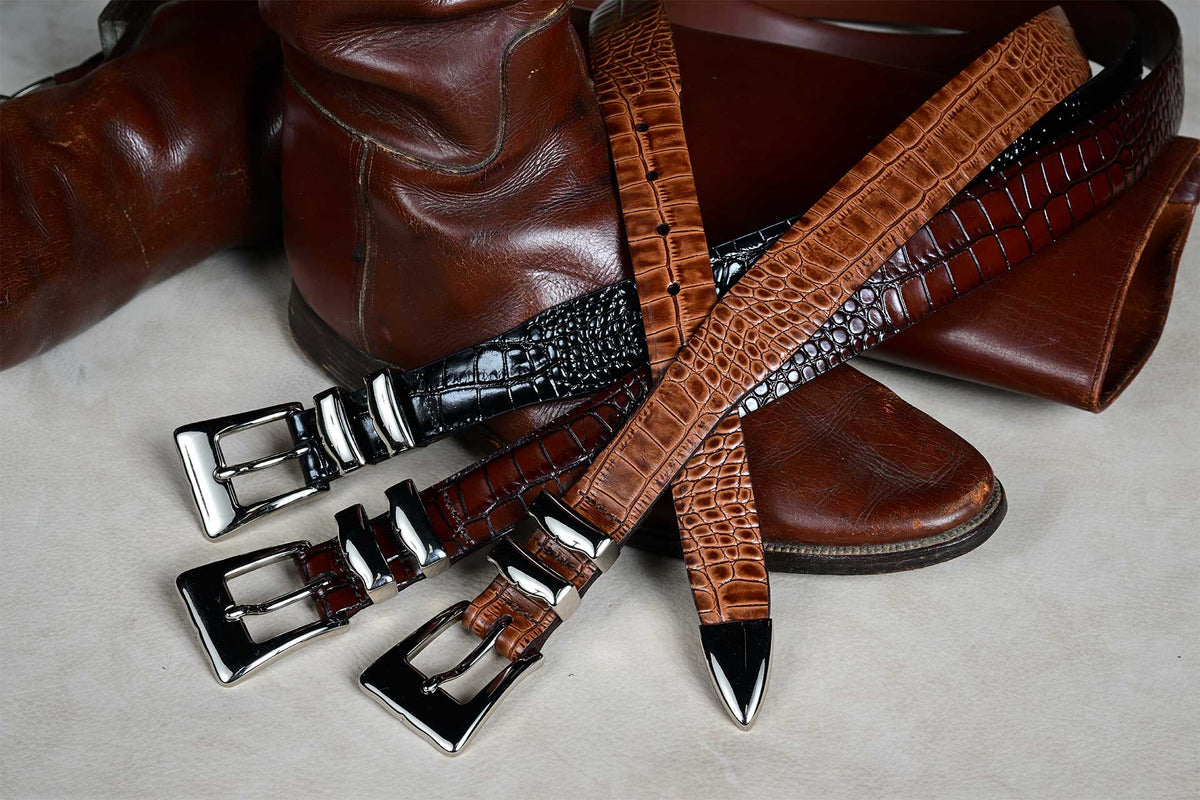
American alligator and caiman are genuine crocodilian hides from different species. Ostrich is a real hide with quill follicles left by the plucked feathers, and it stays notably soft. Pirarucu and lizard are their own materials again. All are named by species, because "exotic leather" is a category and not an animal.
Embossed calfskin is calfskin stamped with an alligator, hornback crocodile, or lizard grain. It is calfskin, we say so in the product title every time, and it is a good belt at around $125. The tell in the hand is the repeat: a die repeats down the strap, a hide does not. Full breakdown, including cuts and why the prices land where they do, in the alligator, caiman, and embossed calfskin comparison. Genuine hides sit in Exotic Belts, stamped calf in Embossed Exotic Belts.
Woven, braided, and stretch belts
Three names that get used interchangeably and should not be.
Woven leather is narrow strips of calfskin woven over and under into a flat strap. It looks like the leather it is, and it gives an inch when you sit down because the weave flexes. Woven Leather Belts.
Braided leather is strands plaited with open gaps, so the prong goes anywhere rather than into fixed holes. Effectively infinite adjustment, and forgiving if your waist moves. Braided Belts.
Woven stretch has elastic in the weave with leather tabs at each end. Most give, most comfort, and the one material here that genuinely wears out rather than ages, because elastic has a finite life. Worth it anyway for golf and hot weather. Woven and Stretch Belts, with team colorways in Game Day Belts.

What to look for in a buckle
Solid metal, plain shape, proportionate to the strap. Brass and nickel are the two finishes worth having, and the choice is a wardrobe question rather than a quality one: nickel with cool tones and silver watches, brass with browns, tan, and gold. Plated buckles wear through at the corners eventually and solid brass does not, though brass dulls and wants an occasional polish. The difference matters less than whether the buckle is the right size for the belt.
On removability: some belts have a buckle that snaps off, letting you swap hardware or change straps. Some do not. It is stated per product, and where it is not stated, assume it is not designed to come off. It is not a category feature, and any brand that tells you all their belts swap is describing a small part of their line.
Does your belt have to match your shoes?
With a suit, yes, closely. Black shoes take a black belt. Brown shoes take a belt in the same family of brown, and close beats exact.
Everywhere else, no. With jeans or chinos the rule has been dead for a while, and the modern version is just not to clash. A tan suede belt with dark brown boots looks considered. A shiny black dress belt with brown casual shoes looks like you did not have a choice. The finer point nobody mentions is metal: keep the buckle in the same family as your watch case.
What should a belt cost?
Belts across our line run $65 to $575, with a median of $120 and the bulk of the line between $75 and $155.
The honest shape of that curve: below about $60 you are usually buying corrected or bonded leather that delaminates rather than ages. Between roughly $75 and $155 you are buying a well made single thickness strap in real calfskin, bison, suede, or woven leather, and that is where the value is. Above $150 you are almost always paying for a rarer hide rather than a longer life, because a $520 alligator belt will not outlast a $120 calfskin one. Different purchase, not a better belt.
Price should be explainable. If nobody can tell you why a belt costs what it costs, that is your answer.
As for how long any of it lasts: worn in rotation and kept out of the dryer, a decade is normal. Worn every day with no rest, less. Rotation does more than anything you can buy in a tin, and the reasoning behind that is in how to make a leather belt last ten years. Leather is a material, not a promise.
Where to start
If you are replacing one belt and want it done: 1 3/8 inches, smooth calfskin, plain buckle, trouser waist plus two. That covers the majority of what gets bought, and it sits in Dress Belts.
Every product page at Kest Leather names the maker, the country, and the material, so you can check any of the above before you buy rather than emailing to find out. If you would rather ask a person, the number is on the contact page.
Common questions
What is the best leather for a belt?
Depends on the job. Full grain vegetable tanned calfskin for a belt you want to see age. Chrome tanned calfskin for a black dress belt that should stay black. Bison if you want the scuffs to be part of the look. There is no single answer, and anyone giving you one is selling one material.
How wide should a men's belt be?
1 3/8 inches if you are buying one belt. 1 1/8 for formal tailoring, 1 1/2 for jeans. Measure your trouser loops before you decide, because a 1 1/2 inch strap physically will not go through most dress trouser loops.
Is an expensive belt worth it?
Up to about $150, yes, because you are buying construction and material that lasts years longer than a $30 belt. Above that, you are buying a rarer hide, which is a legitimate thing to want and is not the same as buying durability.
How many belts does a man need?
Two, minimum. One narrow and dark for tailoring, one wider and textured for denim. Two is also the number that lets you rotate them, which is the single biggest factor in how long either lasts.
One belt, decided properly
Size, width, dress or casual, leather, buckle, price. Work through them in that order and the shortlist gets small fast. The full belt collection is filtered by both style and leather, so you can start from whichever decision you have already made.

Written by Logan Wood
Founder of Kest and a certified master bespoke clothier. He has worked in fine men's clothing since 2017 and handpicks everything Kest carries.